
I got a couple of weeks’ work, and knew exactly what I wanted to do with my life!
I was born in London. My family moved to Southend in 1959 where I attended Victoria Avenue School (which closed and was demolished to build the Civic Centre) then Hamlet Court Road School and then on to St. Bernard’s Convent High School, where the arts and theatre teachers were brilliant, hence: Anne Stallybrass, Helen Mirren and Suzanne Heath, and lowly mortals like myself, were much inspired and encouraged.
After school I went to Southend Art School for two years, doing my A levels. While waiting for replies for acceptance from Dip AD colleges, I initially got a couple of weeks’ work at the Palace Theatre helping set designer Dorothy Draper, and that was it, theatre beckoned: I knew exactly what I wanted to do with my life! Luckily I was offered a full-time job as a scenic artist and paint assistant straight away!
This was in 1969. In those days we painted absolutely everything: no real mouldings or wallpaper! I particularly remember the proscenium arch for Dick Whittington and his Cat (December 1972). The colour and style of the curtains were exactly like the traditional trompe l’oeil proscenium arch in le Grand Theatre in Bordeaux, which I had visited. The Palace is still a pretty Edwardian theatre, although not quite so grand, despite the two boxes each side at the front of the auditorium which have ornate gilding like the theatre in Bordeaux.
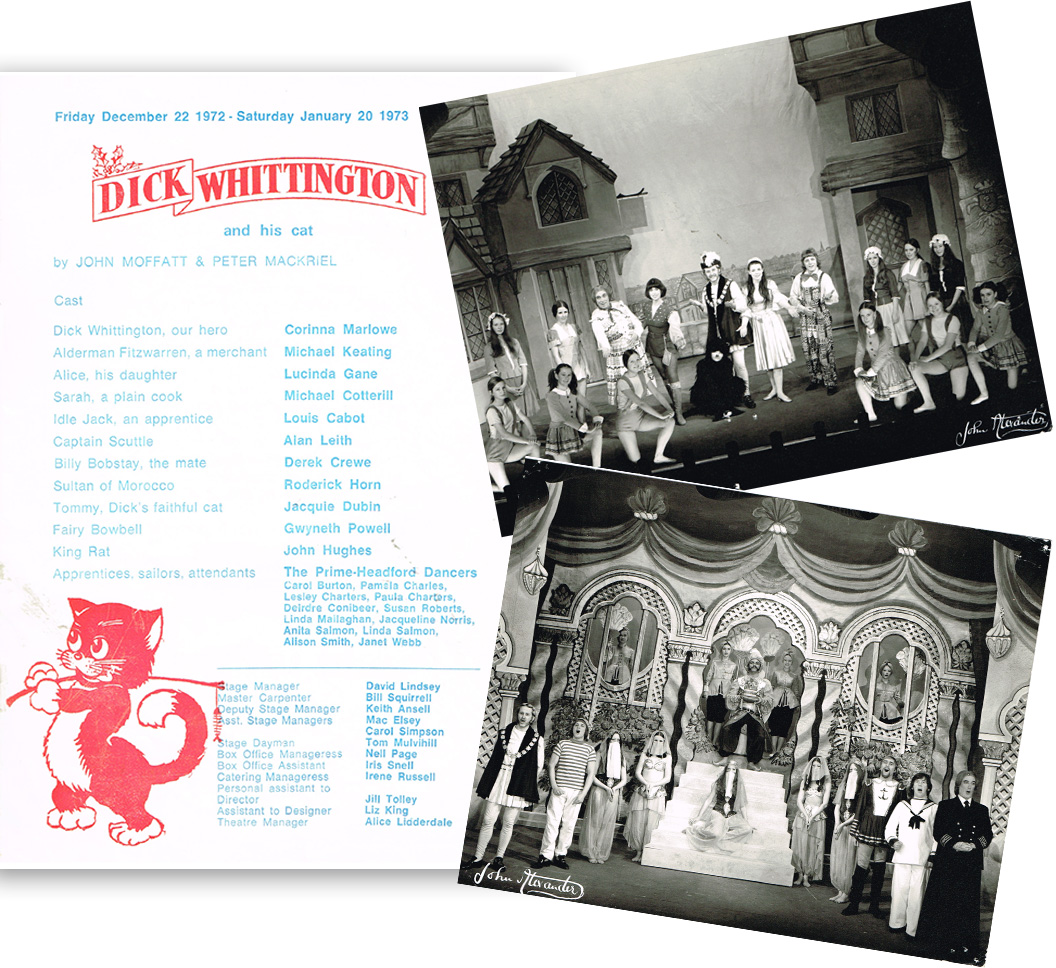
Dick Whittington and his Cat: My “Assistant to Designer” programme credit and two views of the sets. How well I remember painting all that trellis!
The proscenium would have been made up of a series of canvas flats and headers (wood frames) 8m high x 2m wide (in those days 24’ x 6’). They’d have ply attached to one edge which would be cut to shape forming the profile of a swagged curtain.
When I think back, I wonder how on earth did the designer and I paint so many sets required for panto in four weeks? Indeed, during the rest of the year how did we prepare and paint one set in one week, because in those early days sometimes we were doing weekly rep? Later on this more sensibly “eased” into two-weekly rep, but even that was tremendously challenging for everyone in the company. The resident actors would be learning lines and rehearsing during the day for the next week’s show whilst performing the current show that evening. What stamina they must have had and, indeed, what good brains!
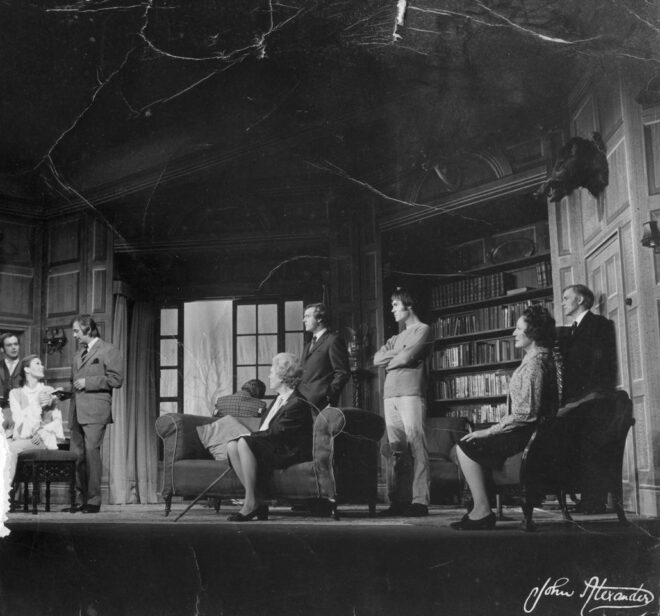
The Unexpected Guest (January 1972). Second from the left is Anne Hamilton, who often appeared on The Morecambe and Wise Show. She was the wife of the artistic director, Tony Clayton.
Meanwhile Dorothy and I were literally at work behind the scenes so we had to work quietly (ever had to shift an 8m by 2m canvas quietly?!). We would work late into the night in order to finish the sets, re-using last week’s flats adapted into different configurations, all painted on their sides because that’s all the work space we had. Dorothy was a wonderful teacher, I learned a lot from her on how to mix colours quickly, to ‘speed paint’ – and get it right first time. No time to stand back with head tilted artistically, you just had to get on with it! She was a very talented and knowledgeable designer, and always came up with a perfect design and colour for every show.
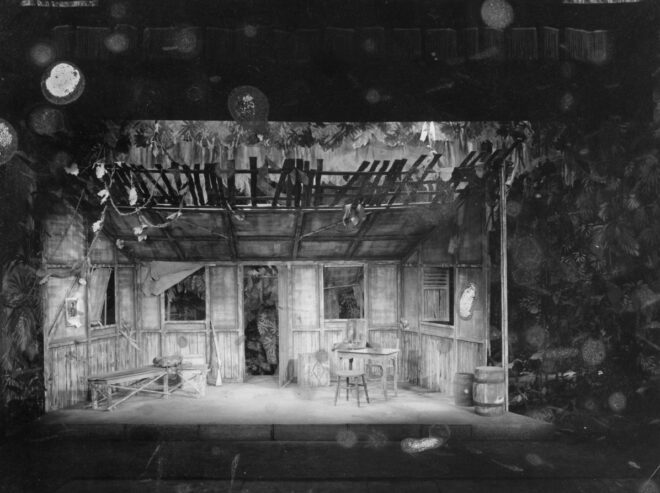
The Long and the Short and the Tall (May 1972)
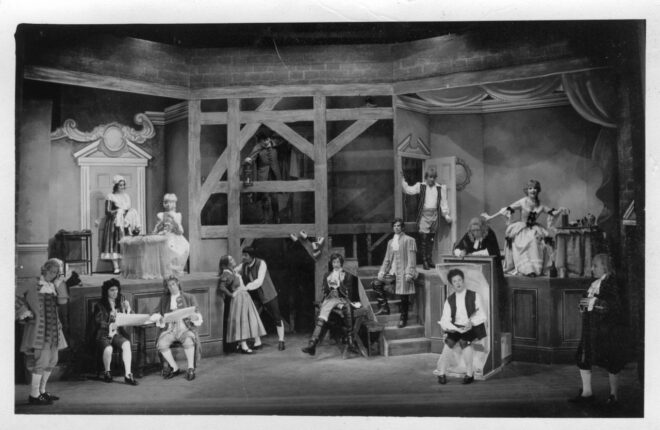
Lock Up Your Daughters (May 1972)
We would prime and repaint the canvas surfaces week after week until the paint layers became so heavy and thick, with the paint looking like a dried riverbed, that sometimes they had to be soaked in boiling water, then scraped back to the original canvas, a horrible job usually carried out by the assistant (me!). Again, this was in the very early days, but as the theatre gradually received more funding we could strip off the old and stretch fresh canvas over the old frames. (I say “we” stretched the canvas, but that was the carpenter’s job.)
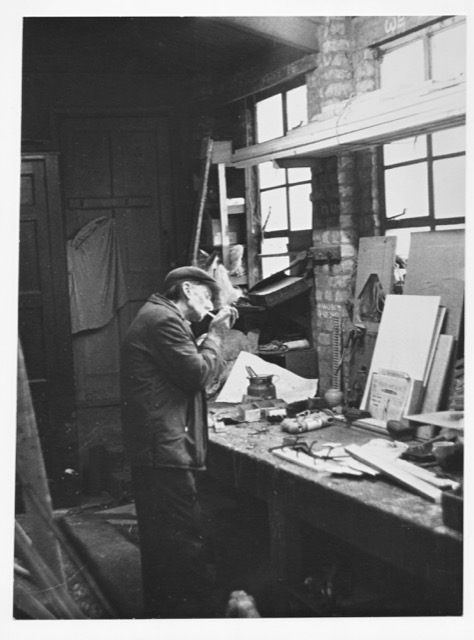
Reg Thake, the carpenter, lighting his famous ‘rollie’. He was a wiry little man with a big ‘Stalin’ moustache, always wearing a cap and with the half-chewed rollie forever stuck between his lips. I remember him having a ghastly suppurating ulcerated wound on his leg, caused by a splinter. It would never heal and he must have been in pain all the time. Bill Squirrell, who took over from Reg, also went to work for the Welsh National Opera. He died at 63 in 2006 or 2007.
As to painting, we mixed the paints ourselves in gallon buckets, using powder colours and chalk mixed with water, and then added boiled size (made from powdered animal bones, skin and hooves) to fix the paint. The crystallised size arrived in hundredweight sacks from Brodie and Middleton, theatrical suppliers, who are still trading in London; prior to use it had to be prepared by dissolving the crystals in heated water. In the heat of summer the paint would quickly spoil into a disgusting stinking gloop, to which we would have to add disinfectant, just to stop ourselves gagging as we painted with it!
In winter, in the unheated tin-roofed shed where we worked, the paints would solidify to a gel overnight, and the first job of the day was to light the gas burners in order the melt the buckets of colour; these were immersed in yet more buckets of water so they didn’t burn, much like a bain-marie. Condensation dripped off the tin ceiling, down your neck, and it was a continual fight to protect the finished flats below from being water-stained.
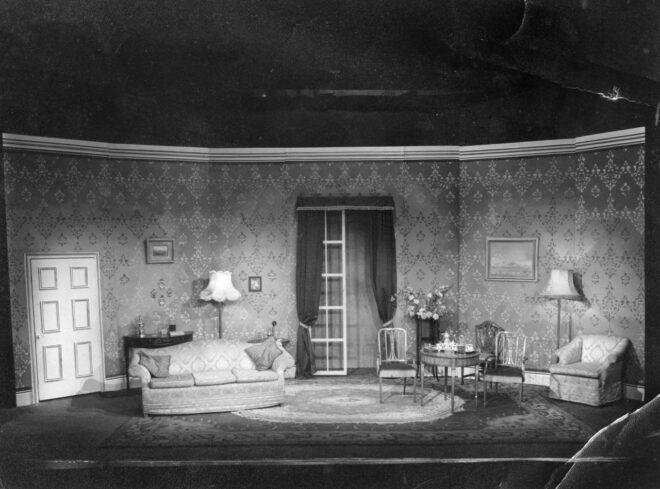
Probably an Agatha Christie. The “walls” were painted with home-cut stencils to look like satin: dark on light, light on dark.
The time all this must have taken….and we still managed to complete the sets, though, I might add, we didn’t smell too good by the end of a working day! This must sound quite Dickensian to the modern ear, so why do I remember enjoying the work? Well it was varied and I met some lovely, interesting people and there was a good feeling of camaraderie. I would muck in if ever there was a spare hand required, if the lighting crew needed help on the antiquated manually-operated board for a slow fade. Or if we were painting a backcloth (on stage because that was the only big space) I would run up to the flies and haul on the ropes to pull the cloth up so we could work on the next strip.
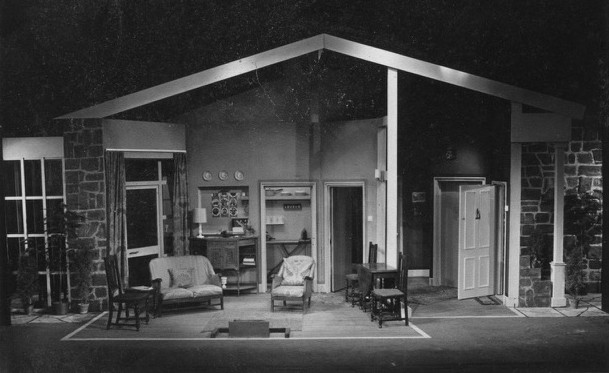
Probably a farce, as they always required a lot of doors!
On Sundays, once the stage crew had struck the previous set, we would oversee the building of the next one; then we would quickly dress it, hastily making curtains and sewing cushions on the spot, hanging pictures, borrowing carpets and furniture from anyone and everyone, packing it all into the one day. The dress rehearsal would be that Sunday evening, with opening night on Monday and matinees on Wednesdays and Saturdays. I feel exhausted just describing it all!!
But there was a lighter side, and we did have some fun. I do remember, in early rehearsals of Journey’s End, where the first attempt at creating the terrifying bomb blast at the climax resulted in hysterical laughter as one ‘slow motion’ plank and a few bits of dust descended from above! But they got it right in the end, and it was very effective. These sorts of things are so difficult to do live, night after night, especially at such an important and poignant moment of the play.
In 1973, after four years, I moved on to work as Head Scenic Artist for (as it was then) the Welsh National Opera and Drama Company. They had better funding than the regional theatres, so I was able to use the more expensive PVA as a fixative base instead of size, which speeded things up. However I had to relearn how to judge the tone the paint would dry to because I was so practised at size-based paints drying two tones paler. These probably sound like trivial skills, but the knowledge saved time which was precious when we were forever working against the clock.
I worked at WNO until 1989, when my husband Graham and I left the UK to live in the south of France – and we’ve been here ever since! We took a chance at first and earned money where we could, doing this and that, then were lucky enough to meet people who appreciated our theatre skills so, on the strength of word of mouth, we set up a small business painting murals and trompe l’oeil, mostly in private chateaux. This also gave me a chance to pursue my own painting, which is something I really wanted to do, so I was exhibiting as well – not to mention that we ran a small B&B and a holiday apartment. So, one way or another, we gained an income so we could stay here, as we do so love France.
We’ve now finished with the B&B and the apartment, and we are enjoying our retirement. I still paint and exhibit, and write and illustrate silly poems, while Graham restores his beloved cars.
[Photos, except for Dick Whittington and his Cat, courtesy of Liz King]
Archivist David Simpson adds: Liz King-Sangster initially contacted me to see whether I was interested in some photos she had found of her time at the Palace Theatre. Naturally I was, but, when she told me more about her work as a scenic artist, I asked her to put together this fascinating Contribution, which gives a wonderful insight into an essential, but largely unsung, backstage activity. As with other contributors, it’s lovely that, despite her time at the Palace being so long ago, Liz still has such fond memories of the theatre and the people she worked with.
And, even in retirement, she remains active. You can check out the work of this very talented artist at lizkingsangster.com

No Comments
Add a comment about this page